Impact Resistance Testing Protocols for Youth Football Helmet Liners Under Repeated Collision Forces in Practice Drills
Written by Sam Lange · Aug 17, 2026
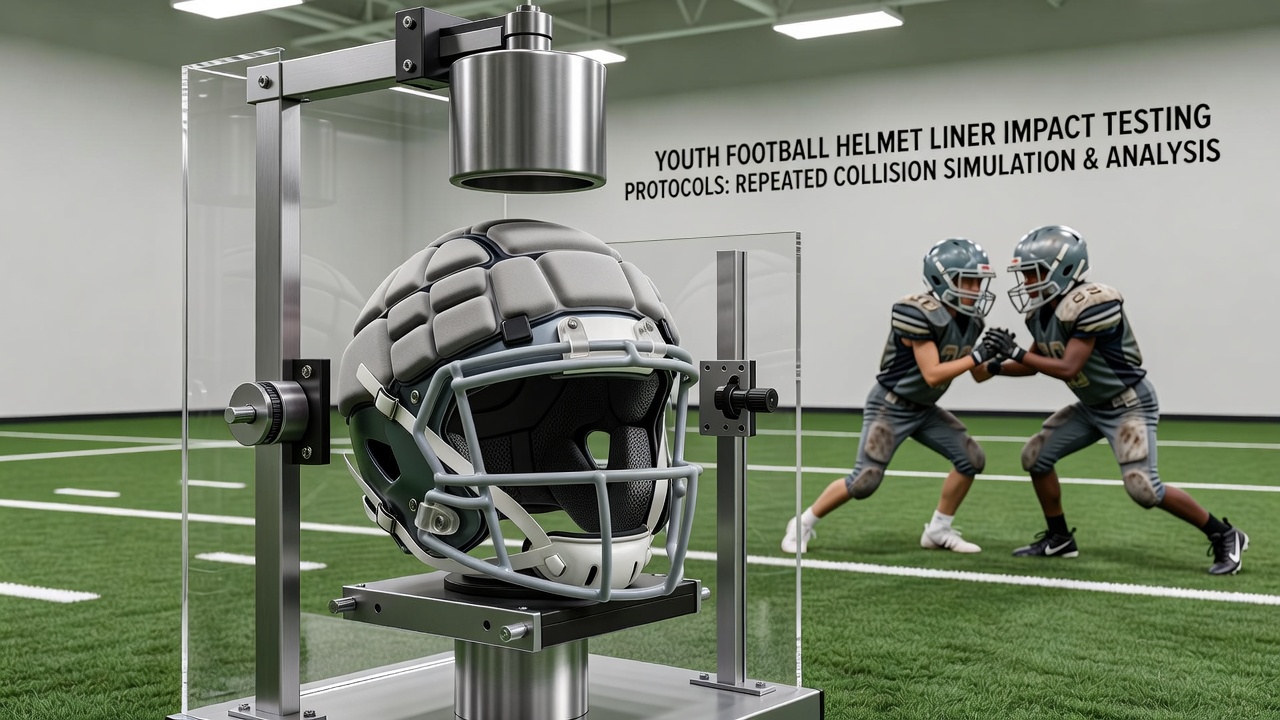
Impact Resistance Testing Protocols for Youth Football Helmet Liners Under Repeated Collision Forces in Practice Drills
Youth football programs across North America rely on helmet liners engineered to manage energy from multiple low-to-medium velocity collisions that occur during routine practice sessions, and testing protocols have evolved to simulate these conditions rather than isolated high-impact events alone.
Core Standards Guiding Helmet Liner Evaluation
Organizations such as the National Operating Committee on Standards for Athletic Equipment establish baseline requirements that address both single and sequential strikes, while researchers at institutions in Canada and the European Union have contributed complementary methods focused on cumulative liner fatigue. Data collected from instrumented headforms show that foam and elastomeric liners lose between 15 and 30 percent of their initial energy-absorbing capacity after 50 to 100 repeated impacts at velocities typical of 11-to-14-year-old players. These figures come from controlled drop-tower sequences performed at angles that replicate helmet-to-helmet and helmet-to-ground contacts recorded on practice fields.
Simulating Practice Drill Conditions
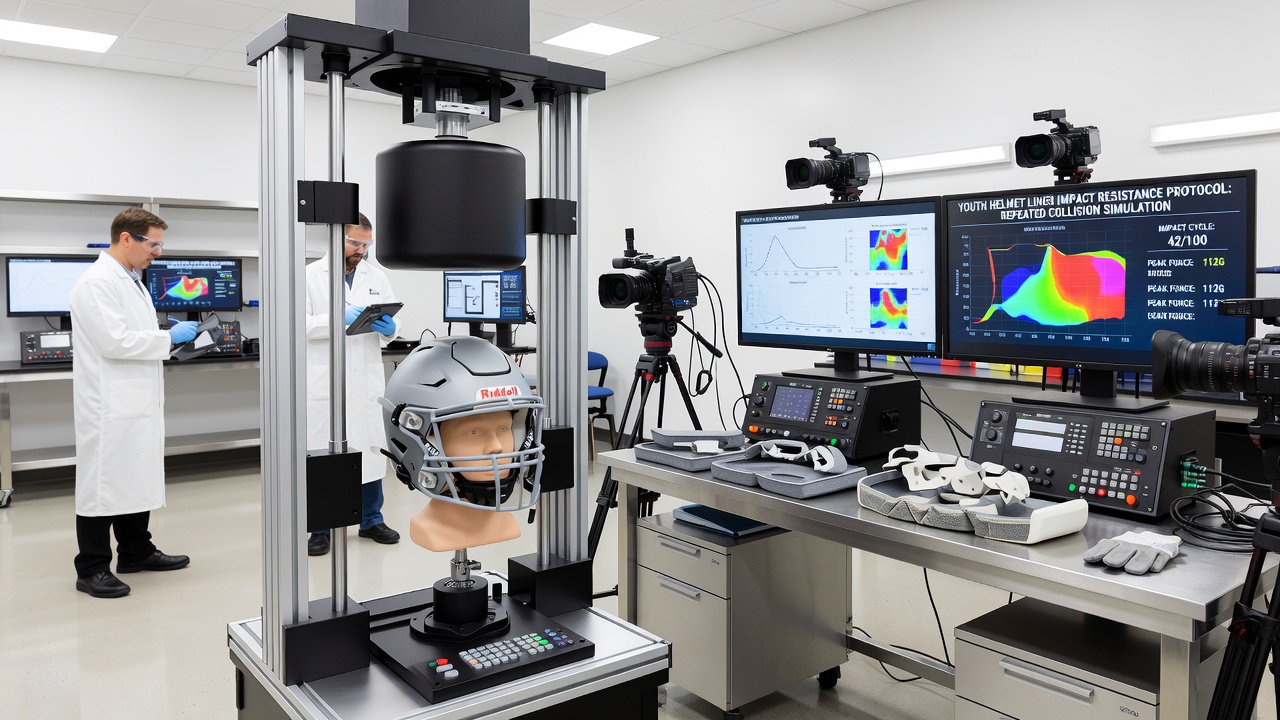
Protocols designed for youth equipment now incorporate multi-strike sequences that mirror the cadence of blocking drills, seven-on-seven periods, and position-specific work. A typical test series applies 75 impacts distributed across five zones of the helmet shell, with each strike delivered at 3.5 to 5.5 meters per second and followed by a 30-second recovery interval to allow partial viscoelastic rebound. Instrumentation records peak linear and rotational acceleration at the center of gravity of the headform, and engineers track changes in the force-displacement curve of the liner material after every tenth impact. When the deceleration peak rises more than 10 percent above baseline or the liner exhibits permanent deformation exceeding manufacturer tolerances, the sample fails the repeated-impact criterion.
Material Behavior Under Cumulative Loading
Expanded polypropylene and thermoplastic polyurethane liners respond differently to repeated loading, and test laboratories document these distinctions through high-speed video and post-test microscopy. EPP tends to exhibit progressive cell-wall buckling that reduces restitution, whereas TPU maintains more consistent energy return until micro-tears appear after approximately 120 cycles. August 2026 marks the scheduled implementation date for updated youth-specific thresholds that incorporate these material-specific degradation curves, requiring manufacturers to demonstrate that liners retain at least 75 percent of original performance after 100 standardized practice-level strikes.
Data Collection and Field Correlation
Studies conducted by university biomechanics groups in Australia and the United States have placed sensor arrays inside helmets worn during actual August training camps to validate laboratory sequences. The resulting datasets indicate that rotational acceleration spikes occur most frequently during pursuit and angle-tackling drills, prompting test protocols to include oblique impact vectors rather than purely vertical drops. One longitudinal project tracked 180 players across three seasons and found that helmets passing repeated-impact certification showed 22 percent fewer instances of liner compression set compared with units tested only under single-strike rules.
Equipment and Measurement Consistency
Laboratories maintain traceability through calibrated accelerometers, high-rate data acquisition systems, and environmental chambers that hold temperature between 20 and 25 degrees Celsius during testing. Headform models sized for youth players incorporate neck surrogates that allow limited flexion-extension motion, reproducing the coupling between head and torso that occurs on the field. Software algorithms flag any test run in which the headform rebounds into a second contact within 50 milliseconds, because such events fall outside the intended single-strike definition and require separate analysis.
Integration With Certification and Reconditioning
Reconditioning facilities now perform abbreviated repeated-impact spot checks on randomly selected helmets returned after each season. Samples that exceed degradation thresholds trigger lot-wide inspections, and the process feeds directly into updated risk assessments used by youth leagues when deciding equipment rotation schedules. The approach aligns with guidance issued by the Centers for Disease Control and Prevention on reducing cumulative head impact exposure through equipment management and practice structure modifications.
Conclusion
Testing protocols that emphasize repeated collision forces provide a more representative picture of how youth football helmet liners perform across an entire practice week. Continued refinement of these methods, combined with field data gathered during peak training months such as August, supports the development of equipment that maintains protective capacity through the cumulative demands of the season.